
Key Findings
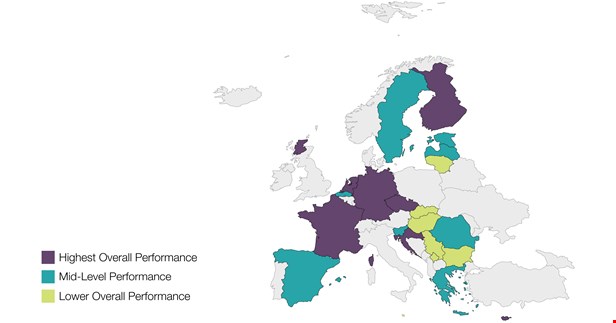
The map of Europe reveals a geographical pattern:
- With Northern and North-Western European countries generally performing best. Scotland, the Netherlands, Germany, Finland, Sweden, Flanders and France all appear in the upper half of the table, with several occupying the top positions.
- Central and Southern Europe display mixed results. Czechia ranks relatively high, while Slovenia, Slovakia and Hungary fall into the mid to lower range, reflecting variations within Central Europe.
- Southern Europe is similarly heterogeneous: Cyprus performs strongly, whereas Greece, Spain and Malta are positioned in the lower part of the ranking.
- By contrast, Eastern and South-Eastern European countries are generally lagging behind, with some variations.
- In the Baltic region, Estonia performs better than Latvia and Lithuania.
The rankings and the country profiles are based on self-reported data by patient organisations and data collected between March and July 2025. They are intended to provide an indicative overview rather than definitive comparisons.
An incomplete institutional framework across Europe
The Barometer highlights significant gaps in the institutional frameworks governing patient organisations’ involvement.
- Approximately half of the countries report the existence of a formal framework, while more than one-third report none;
- Implementation of existing frameworks is not viewed positively by patient organisations;
- Only four countries (Germany, Netherlands, Bulgaria, Czechia) have a formal legal definition of patient organisations;
- Data suggest that countries with institutional frameworks are more likely to involve patient organisations at earlier stages of policymaking.
Uneven participation mechanisms across policymaking processes
Patient organisations’ participation in policymaking remains inconsistent across Europe:
- 22% report being consulted very frequently;
- 35% regularly;
- 35% occasionally;
- 9% rarely.
Common engagement mechanisms include advisory boards, working groups and stakeholder consultations. Participation in parliamentary committees is less frequent, while involvement in regional or hospital boards is rare.
Transparency remains a critical blind spot
Transparency in patient organisations’ involvement remains insufficient:
- A majority of countries (13 out of 23) report no clear or transparent criteria for patient organisations’ involvement ‘in policy and regulatory processes in their country;
- In some cases, a diverse representation seems to be the result of ad hoc or random selection rather than of a transparent, representative and well-defined process;
- Over-reliance on individual patient experts instead of structured organisational representation remains a cause of concern. While individual contributions can play an important role in raising awareness and bringing personal experiences into policy discussions, patient organisations are uniquely positioned to aggregate these experiences, reflect a collective voice in all its diversity, and translate them into constructive policy proposals.
The examples of regulatory and HTA involvement
At national level, patient involvement in regulatory processes for medicines and medical devices remains limited, despite the unique expertise patient representatives bring through lived experience and disease knowledge.
In HTA processes:
- More than half of responding countries report that patient organisations are involved in national HTA processes; however, direct participation by individual patients is less frequent;
- Where patient organisations are involved, participation is mostly ad hoc rather than institutionalised;
- When patient organisations play a more significant role in the national HTA process, they tend to benefit from more extensive rights in terms of reimbursement options and policy initiatives on access.
Barriers and enablers to meaningful patient organisations’ involvement
- Patient organisations face a multitude of barriers to meaningful involvement in policy-making, including low political recognition, fragmentation of health systems, and limited expertise, but an overwhelming majority of countries (91.3%) identify lack of resources as the main barrier.
- Most organisations combine multiple sources of funding, which supports increased sustainability but requires considerable effort in terms of fundraising and administration.
- Government grants are the most common source of funding among all countries surveyed (13 countries out of 23), but still account for only a small proportion of organisations' financial resources.
- In only about one third of the countries surveyed do patient organisations have access to government-provided capacity-building or training programmes.
From voices to impact – how patient organisations’ are changing healthcare systems
The Barometer showcases over 30 national case studies and best practices across Europe, demonstrating how patient organisations contribute to:
- Stronger inclusion of patient perspectives in healthcare systems;
- Supporting patients in the transition to digital health;
- Supporting disease-specific advocacy;
- Enhanced patients’ rights;
- The design and implementation of large-scale prevention campaigns.
Changing the narrative around patient organisations – From “nice-to-have” to strategic partners in social services and research & development (R&D)
At both European and national levels, there is an increasing focus on “competitiveness” and “simplification.” In a broader context of resource constraints affecting health systems—driven by an ageing population and the rising costs of innovative, personalised treatments—patient organisations face growing pressure to demonstrate their role and prove their added value.
In line with the EPF Barometer, national coalitions of patient organisations, such as those in the Czech Republic, Poland, and Slovenia, have produced comprehensive, data-driven reports to showcase their added value.
The EPF Barometer supports a shift in perception, positioning patient organisations as strategic partners in health systems, social services, and research and development.